One of our latest projects is the Sheep Creek Mine Water Quality Mining Project:
The Bitterroot River Health Check program began conducting its own baseline water quality study related to the Sheep Creek Mine Exploration Project in the fall of 2024 and it is ongoing.
WHY IS IT BEING DONE?
It is being done because establishing the condition of the surface water in the project area is one of the best ways to document one of the most valuable resources at risk, and in this case it is the pristine headwaters of the Bitteroot River. It is also crucial in determining the extent and degree of any degradation that may occur and hold the responsible parties to account. Several organizations – international, national, regional and local – were contacted about how best to proceed. faced with this mining proposal. Virtually everyone consulted suggested that getting some baseline data on the present conditions should probably be a top priority.
The agencies involved, the Forest Service and Montana DEQ, are not going to do any monitoring. At best they will require the company to do it. But it was recognized early on, that if the company is granted a Categorical Exclusion or if DEQ accepts a Small Miners Exemption application, which is what the company was stating they intended to do at the time, no environmental assessment would be required and possibly no monitoring. But the fact is that even if they are required to do it, we cannot afford to trust this company to monitor themselves. They have proven themselves to be untrustworthy and intent on avoiding any environmental analysis on either the state or federal level.
WHAT IS BEING DONE?
Four sites were established in the fall of 2024, above, within and below the project area. A fifth site was added at the top end of Painted Rocks Reservoir this year. The monitoring continues and additional sites are being planned now that the company has disclosed the location of its excavation and drilling activities. The data being collected includes physical parameters, nutrients and a long list of metals and rare earth elements.
WHO IS DOING IT?
The work is being conducted by the Bitterroot River Health Check program which has established an extensive network of 27 monitoring stations across the watershed and is headquartered at the Bitterroot College. Partners include the Forest Service, Montana DEQ, Bitterroot Conservation District, UM Watershed Health Clinic, Montana Watershed Coordination Council, Clark Fork Coalition, Ravalli County Fish & Wildlife Association, Friends of the Bitterroot, Bitterrooters for Planning and the Bitterroot River Protection Association.
The Bitterroot River Health Check program is an all-volunteer “citizen science” based cooperative that offers free training in water quality sampling protocols to all its volunteers. For more information about the monitoring project or if you are interested in volunteering contact Michael Howell at bitterrrootriverprotection@gmail.com or call (406)239-4838
The Bitterroot River Health Check program is a community-based water quality monitoring program supported by of a collective of individual community members, local businesses, and non-profit organizations, as well as the Bitterroot College.
“Citizen Science” based
The Bitterroot River Health Check program sponsors a team of vounteer monitors trained in the protocols for taking water quality samples in the river, streams and lakes of the Bitterroot River Basin. The all-volunteer teams work without charge to aid agencies such as DEQ, FWP and others in agency sponsored water quality montioring projects, in training and educational programs at the Bitterroot College and in university related research projects, as well as other independent water quality monitoring projects in the Bitterroot River watereshed.
Education oriented
The Bitterroot River Health Check Program has a Memorandum of Understanding with the Bitterroot College University of Montana allowing for the use of college laboratory facilities and storage in exchange for the use of the river health program’s equipment for classroom educational purposes. The two cooperate in educational and training programs related to the Bitterroot River Watershed.
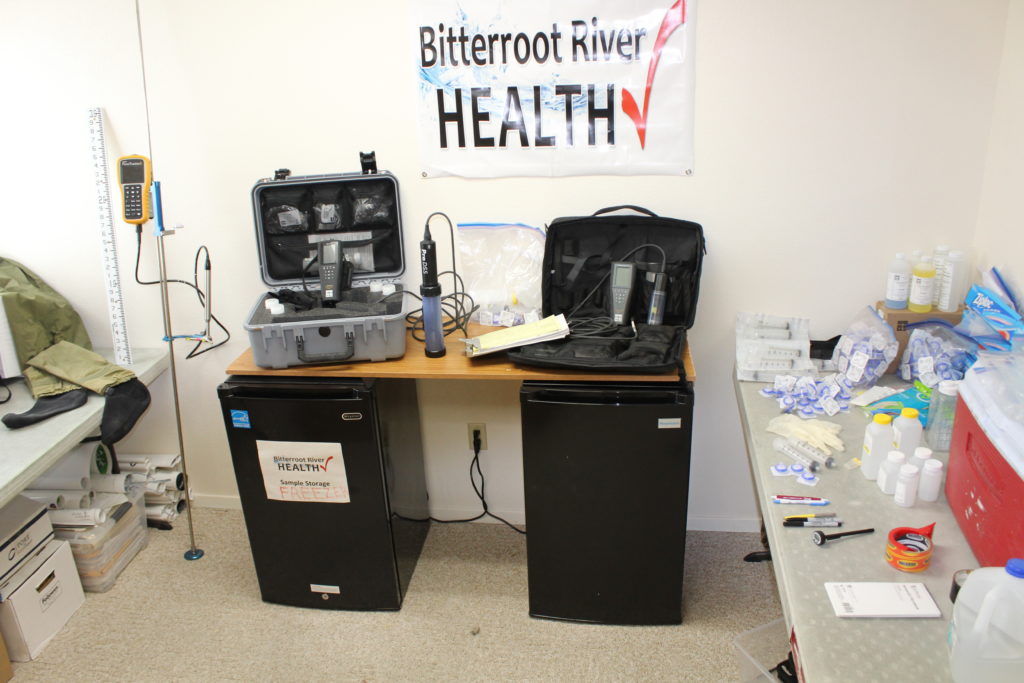
Monitoring the Bitterroot River Basin since 2017
In 2017, BRPA adopted the stated goal of establishing a system of water quality monitoring sites on the Bitterroot River and its major tributaries that would serve as a grid for assessing the watershed’s health by providing baseline data from across the watershed in perpetuity. It would be a network of sites that could be used in assessing impacts of the landscape scale management projects and restoration activities currently under way in the watershed and the ones planned in the future.
During the summer of 2017 a team of 10 volunteer monitors from the Bitterroot River Health Check program began participating with DEQ, the Clark Fork Coalition and the University of Montana Watershed Health Clinic, in a long-term water quality monitoring project on the mainstem of the river.
As part of that process Vicki Watson from the UM Watershed Health Clinic produced a nutrient and algae data report for the Bitterroot that is still guiding DEQ and BRPA in its nutrient testing programs in the watershed.
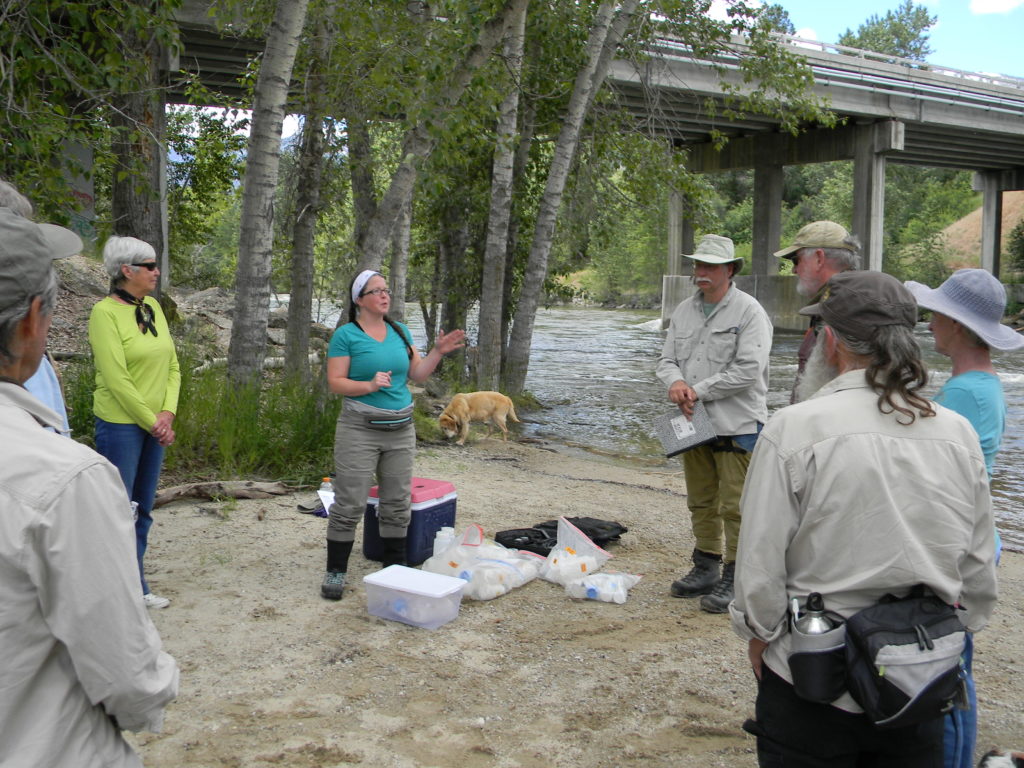
The effort to establish this network of sampling sites has been proceeding in phases and enjoyed phenomenal success over the last six years:
PHASE 1: The Bitterroot River Mainstem Project has led to the establishment of six sites on the river, five of which are now included in Montana Department of Environmental Quality’s 20-year plan (2019-2039) for long term monitoring nutrients in the Bitterroot River. DEQ pays for laboratory analysis at five sites while BRPA pays for the analysis of the 6th site at Veterans Bridge which serves to bracket the Hamilton metropolitan area, adding significant information to the long-term trend data.
PHASE 2: The Sapphire Front Project was initiated in 2018 as a logical extension of the mainstem monitoring, especially in relation to nutrients and expanded our network of sites to include Rye Creek, North Rye Creek, Skalkaho Creek, Willow Creek, North Burnt Fork Creek, and Three Mile Creek. All of these streams have been listed for some type of impairment or multiple impairments in DEQ’s 2014 Bitterroot TMDL. Impairments vary for individual streams but include nutrients, sedimentation, temperature, low flow alterations, and alteration in stream-side or littoral vegetation. BRPA has been collecting data annually since that time and is currently receiving financial aid in the form of grants from DEQ’s Volunteer Lab Analysis Fund and from the Flathead Lake Biological Station (FLBS) Monitoring Montana Waters fund.
PHASE 3: The Bitterroot Front Project is a landscape scale project proposed by the Bitterroot National Forest covering the entire westside of the valley from Darby to Lolo. BRPA has signed an MOU with the Bitterroot National Forest to help establish a set of long-term water quality monitoring sites in the project area. This is all in the pre-planning stages but is also moving towards some defined projects within the area which may be conducted under the National Environmental Policy Act (NEPA) in the near future. We plan on working closely with DEQ on the water quality sampling protocols we employ and with the Department of Natural Resources and Conservation (DNRC) on the protocols for collecting flow measurements. We are also partnering with Dr. Payton Gardner, Assistant Professor of Hydrogeology at the University of Montana, whose team (one postdoc and two graduate students), helped in installation of gages and pressure transducers at sampling sites on three streams on the Bitterroot Front in 2021.
Sheep Creek Mine monitoring – BRPA has begun preparation of a Sheep Creek Mine Sampling and Analysis Plan to sample for nutrients and metals in the headwaters of the West Fork of the Bitterroot River in the area of a proposed Rare Earth Elements mine in the Sheep Creek and Johnson Creek drainages with the aim of establishing a base-line for physical parameters, nutrients, over twenty different metals, and over half a dozen major anions as well as data on benthic algae, chlorophyll-a and macroinvertebrates.
Volunteer non-profit
The Bitterroot River Protection Association is a 501(C)(3) non-profit and donations to the Bitterroot River Health Check program are tax deductible. Donations to BRPA’s Bitterroot River Health Check program are spent only on equipment, supplies, laboratory/data analysis and professional services when required. Monitoring team members are all volunteers.
PROGRAM PARTNERS INCLUDE:
Bitterroot River Protection Association
Bitterroot College University of Montana
University of Montana Watershed Health Clinic
Montana Department of Environmental Quality
Bitterroot National Forest
Montana Watershed Coordination Council
Bitterroot Chapter Trout Unlimited
Ravalli County Fish and Wildlife Association